
How China’s Leader Plans to Win the Future With A.I.


A decade ago, Xi Jinping asked if China could master A.I. His push is remaking the economy, challenging the United States and keeping society under control.

Vivian Wang reported from Beijing and Shenzhen, speaking to Chinese A.I. researchers and entrepreneurs.
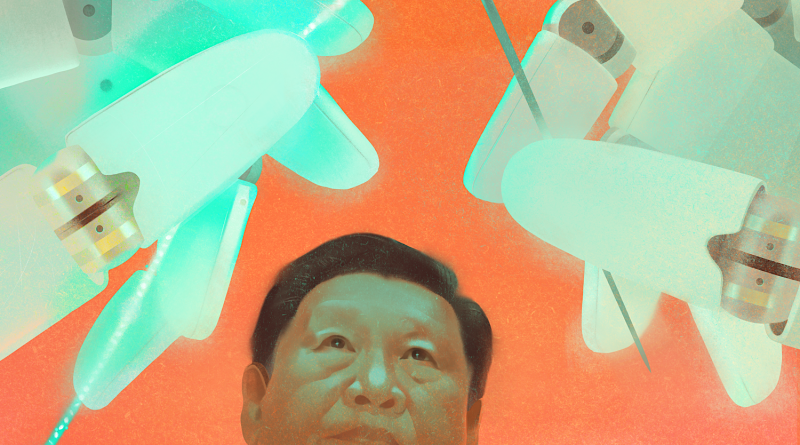
In a stretch of former farmland now transformed into a gleaming technology park, China’s leader, Xi Jinping, watched two robotic hands slowly thread a needle. What he was seeing, he declared, would help China seize its future.
It is a future in which artificial intelligence permeates China’s factories, hospitals and classrooms, reinvigorating the economy through advanced robotics and high-end manufacturing. It is a future in which China, not the United States, dominates A.I. development, turning the technology into what Mr. Xi has called a “lead goose” to fly the country into its next economic revolution.
To realize that vision, the Chinese government is mobilizing the full weight of the state.
At the park that Mr. Xi visited, on the outskirts of Beijing in February, hundreds of companies have set up offices to develop cutting-edge chips and A.I. models. The city government is giving them tens of millions of dollars in free computing power. An exhibition hall shows off their creations, including chips designed to power nuclear missiles and brain implants that could help paralyzed patients speak.
Mr. Xi, during his visit, said that China’s strength lies in its ability to zero in on a direction and follow through.
“We must give full play to our nation’s advantage of concentrating resources to accomplish major tasks,” he told an assembled group of entrepreneurs, researchers and officials.
China’s A.I. campaign is backed by enormous sums of government money. Economists estimate that state-led funds put more than $184 billion into A.I. firms between 2000 and 2023, and last year, the government and state-owned banks pledged hundreds of billions more. Private A.I. investment in China is far lower than in the United States, where private sources poured $285 billion into the technology in 2025 alone.
Beijing’s approach to A.I. is distinct from the prevailing one in the United States in other ways, too.
Many in Washington and Silicon Valley see A.I. development as a race toward artificial general intelligence, a still-theoretical form of A.I. that could think and learn as well as — or better than — humans.
Chinese officials have hardly mentioned A.G.I., focusing on more immediate goals.
China’s population is rapidly shrinking and getting older, creating an urgent need for intelligent robots to replace retiring workers. Poor rural residents could seek medical care from digital avatars of top urban doctors. The authorities could more easily know where Chinese citizens are, what they say and perhaps even how they feel.
The government has said that A.I.-powered tools and agents should permeate 90 percent of Chinese society by 2030, though it has not explained how that would be measured.
Mr. Xi has also endorsed Chinese companies’ use of open-source models, which have helped them win users globally when leading American companies have released closed systems.
China has embraced A.I. despite the potential risks it poses to the Communist Party’s legitimacy and tight grip on society.
The technology is already displacing taxi drivers, actors and office workers, heightening worries about joblessness and potential unrest.
Chatbots could threaten the party’s controls on information, while advanced foreign models like Claude Mythos could make it easier for China’s enemies to launch complex hacking attacks on its critical infrastructure — a threat the country’s top spy chief recently acknowledged.
Mr. Xi is betting that China can control those dangers.
Regulators have imposed strict rules on what chatbots can say and banned A.I. companion bots for children. Chinese courts have warned companies not to blindly replace workers with technology. The authorities have also barred some leading A.I. entrepreneurs from leaving China.
But Beijing’s confidence in its controls, and its determination to catch up with the United States, also mean it is skeptical of global calls to slow the pace of A.I. development.
In Beijing’s view, China is already fighting from behind. Washington has limited China’s access to the most advanced chips, so China lacks the computing power that is needed to train cutting-edge A.I. Agreeing to slow down now, in this view, would only cement America’s lead.
The 2014 Speech That Started It All
In Beijing’s Great Hall of the People, China’s top scientists gathered for a speech by Mr. Xi. It was June 2014, the first time that Mr. Xi addressed China’s Academies of Engineering and Sciences as the country’s leader.
The attendees had submitted reports beforehand, and Mr. Xi said he had read them closely. He said he was particularly intrigued by one report predicting that A.I.-powered robots would soon transform the global economy. Such machines, unlike traditional robots that repeat specific preprogrammed tasks, can use A.I. to learn from and adapt to their surroundings. China would be the biggest market, the report said.
That wasn’t enough, Mr. Xi said. China should be not just the biggest buyer, but also the top maker.
“Reading this, I wondered,” he added, “can our technology and manufacturing capabilities keep up with the competition?”
That speech set off a frenzy that still shapes China’s A.I. policy today.
Immediately afterward, Pan Yunhe, the Chinese Academy of Engineering’s vice president and a respected A.I. researcher, organized a team to design a long-term strategy for the country, according to Gong Ke, a professor in Tianjin who leads an A.I. research institute under the academy.
China was well positioned to take the lead in A.I., Professor Pan wrote in a research paper shortly afterward, because its huge population ensured that there was both a great supply of data to train models, and great demand for intelligent products. He also wrote that China urgently needed A.I. to address problems that the country’s rapid modernization had created; smart manufacturing and A.I.-assisted education, for example, could help address issues such as pollution and inequality. (Professor Pan declined an interview request.)
In 2017, China issued its first national A.I. plan, which, in parts, used language virtually identical to Professor Pan’s paper. It said that China should become a world leader in the technology by 2030.
In the years after the plan was released, China’s A.I. sector expanded rapidly. State and private investors pumped in money. The number of A.I. patents by China soon blew past that of the United States.
From the start, Beijing saw A.I. as a force, like the internet, that could shore up the party’s power. It could help maintain public satisfaction by boosting economic growth. It could also head off potential unrest by helping the party monitor China’s people.
Manufacturers pushed A.I. into factories and warehouses. Surveillance companies became global leaders in facial and voice recognition. At one point in 2018, SenseTime, a Beijing-based company that has helped the government police China’s Uyghur minority, was the world’s most valuable A.I. start-up.
But Chinese researchers were generally not focused on large language models, as American researchers were. When ChatGPT appeared in 2022, China reeled. Commentators who had boasted of China’s lead in A.I. asked why the breakthrough had not come from their country.
Then, last year, came DeepSeek. The previously unknown Chinese start-up stunned the world by showing that Chinese firms could compete with Silicon Valley on large language models, too. In February 2025, a few weeks after DeepSeek released its model, Mr. Xi summoned a group of Chinese tech executives — including DeepSeek’s founder — to a meeting.
“It is the right time for private enterprises and entrepreneurs to fully demonstrate their abilities,” he said. Those gathered must “unify our thinking” and “serve the country.”
A Recipe for Dominance
Beijing is not just tapping its biggest tech tycoons for that mission. State support is supercharging individual ambitions across the country, as Hobo Liang, a 42-year-old entrepreneur in the tech hub of Shenzhen, has seen firsthand.
The son of mathematics professors in northern China, Mr. Liang was drawn to machines from an early age. In elementary school, he built homemade radios from spare parts. At university in the mid-2000s, he studied electrical engineering and decided to start a robotics company.
People around him were doubtful. One potential investor asked Mr. Liang why China needed robots when it had so many people. His parents urged him to apply for stable jobs at state-owned companies. China’s high-tech sector was in its infancy, and many of Mr. Liang’s heroes were in the United States: Steve Jobs, Elon Musk. He even idolized a fictional entrepreneur — Tony Stark, of Marvel’s Iron Man movies.
Today, Mr. Liang still keeps an Iron Man figurine on his desk. But that early skepticism feels far away. His start-up, Xeno Dynamics, which makes robotic exoskeletons for people with mobility issues, recently moved into a new government-built industrial park, next door to China’s leading drone maker.
Xeno has been recognized as a national high-tech enterprise, meaning its tax rate is reduced from 25 percent to 15 percent. It has received over $1.4 million in government research funds, as well as multiple rounds of venture capital funding.

“We’re beneficiaries of the entire direction — whether it’s about robots, or A.I.,” Mr. Liang said in an interview in his office. “You have to follow the direction of major policies.”
In many ways, China’s playbook for A.I. mirrors the one it used to dominate electric vehicles and solar panels: subsidies, tax breaks and research money.
A district in Shanghai offered up to $29 million to any A.I. company that achieved a major “breakthrough.” A university hub in Beijing said it had spent about $580 million on A.I. last year, funding data annotation centers, labs and housing for researchers.
In Shenzhen, officials spent more than $6 billion on the industrial park where Xeno’s offices are located. The district also promised to help robotics companies find potential customers.
The central government, for its part, has been spending heavily on physical infrastructure. Beijing’s newest five-year plan calls for building ultra-large computing clusters and ensuring electricity to power the A.I. boom. Officials are also setting up a national exchange to trade data to train A.I. models.
The Limits of State Planning
But it may be harder for Beijing to engineer mastery in A.I. than in electric vehicles or solar panels.
In those sectors, the technology was fairly developed, and the state’s role was giving companies the financial support to edge out foreign competitors, said Cole McFaul, a researcher at the Center for Security and Emerging Technology at Georgetown University.
With A.I., leadership will hinge on technological breakthroughs. Subsidies can do only so much.
One obstacle is a shortage of specialized talent. Another is the lack of access to the most powerful chips. Indeed, DeepSeek’s founder, Liang Wenfeng, has said that the company needs high-end chips, not more money.
The government is trying to close those gaps. It has poured more than $150 billion into a decadelong effort to develop domestic cutting-edge chips, though that has not yet yielded major successes. It is also working to train more scientific talent.
Still, “those are long-term strategies, when the challenges right now are much more pressing,” Mr. McFaul said.
Officials have acknowledged the need to give the private sector more room. Private companies like DeepSeek and Alibaba, not state-owned giants, have driven China’s breakthroughs.

Instead of micromanaging research, officials have focused on stimulating demand for A.I. Local governments have rushed to embed A.I. in hospitals, schools and traffic systems. Last year, Zhejiang Province organized mass study sessions about A.I., with more than 220,000 party officials watching a live-streamed lecture by a Tsinghua University scholar.
The authorities have even rolled back some of their most burdensome rules.
Soon after ChatGPT’s release, the party had proposed strict regulations on chatbots and other generative A.I., requiring platforms to guarantee that A.I.-generated output was “true and accurate.” After companies argued that would be impossible, that requirement disappeared from the final rules.
Li Zhiqi, a policy adviser to the Beijing city government, said he helped channel feedback from companies to officials, and had proposed suggestions such as faster deployment of self-driving cars. “The government isn’t just making rules behind closed doors,” he said.
The Race to the Top
For now, the approach seems to be working. At the end of 2025, China had more than 6,000 A.I. companies, and its core A.I. industry was worth $171 billion, according to official statistics. Chinese models now consistently outnumber American ones on a list of the most popular A.I. systems worldwide, according to OpenRouter, a closely watched leaderboard of A.I. models. Even Western tech companies like Airbnb have embraced them.
Two Chinese companies recently introduced models that are nearly as powerful as the leading American model, Anthropic’s Claude Fable 5, and cost much less to use.
Robots — the sector Mr. Xi first championed in his 2014 speech — have been a particular success. China has more than 2 million robots in its factories, more than in the rest of the world combined. Some Chinese researchers have argued that robots may be more promising for achieving general-purpose intelligence than large language models — Silicon Valley’s chosen method — because they can learn from interactions with the physical world.
Those rapid gains have fueled anxiety in Washington, where fears of being overtaken by China have become the main argument against reining in A.I. A congressional advisory group warned that China’s quick adoption of A.I. in robots and other practical applications would generate huge amounts of new data that could then be used to further improve its models. In July, the U.S. government proposed restricting imports of humanoid robots, a move Beijing denounced as discriminatory.
For people like Mr. Liang, the robotics company founder in Shenzhen, the signs of China’s progress are already all around.
He still admires American entrepreneurs, but he no longer looks only to them for inspiration. He wears smart glasses from Huawei. He has hired interns from American universities who are eager to learn from China’s robotics expertise.
“Before, we all used American technology as the benchmark, and we’d joke about ‘C-to-C’: ‘copy to China,’” Mr. Liang said. “I think it’s the mission of this generation of Chinese entrepreneurs to let the world know that some Chinese companies are different.”
=====================================================================
Siyi Zhao contributed research.
Vivian Wang is a correspondent based in New York, where she writes about how China’s global rise and ambitions are shaping the lives of people both inside and outside its borders.