
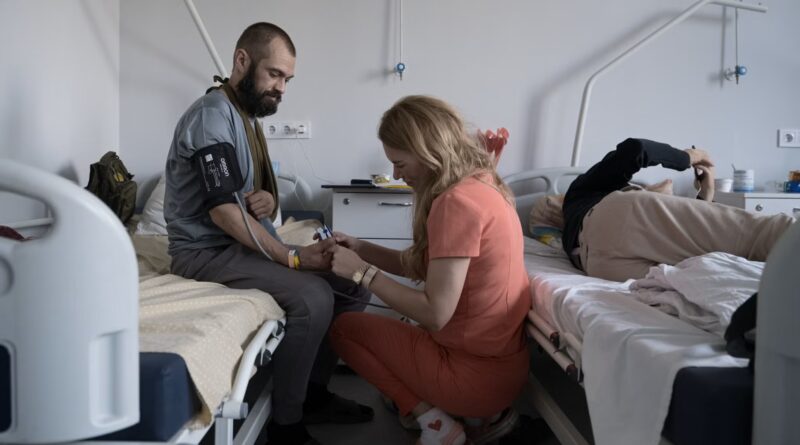
How Drone Warfare Fueled an Infection Crisis in Ukrainian Hospitals

Doctors in Ukraine Try Treating Infections Like Biological Warfare Attacks As many as 40 percent of injured soldiers face severe infections that can lead to amputations and death. One initiative is trying to fix that.


Gina Kolata heard about a new effort to reduce infections in Ukraine while moderating a wartime medicine discussion. Marc Santora visited the site of the dress rehearsal in Poland and spent a day reporting from the disinfection unit in Dnipro, Ukraine
The injuries to soldiers arriving at Ukrainian hospitals are horrific. Instead of bullet wounds, blast injuries from drones dominate the scene: Calf muscles are blown away, chunks of tissue are missing from thighs. Soil and debris thrown up from the blast are lodged deep in lacerations.
By the time they arrive at a hospital, which can take days, weeks or even months of travel under cover of darkness, 30 to 40 percent of soldiers are not just injured but have severe infections. And their infections often involve microbes that are untreatable — resistant to antibiotics. When the injured soldiers are admitted to civilian hospitals, they risk spreading the bacteria to other patients.
Now there is an effort to counter this scourge.
It started with a realization by Hailie Uren, a clinical pharmacologist and disaster medicine specialist who works in Ukraine. The situation, she reasoned, resembled nothing so much as a biological warfare attack. “If we don’t have antibiotics to treat these patients,” she said, “how different is that from when a patient is exposed to anthrax?”
Hospitals already have plans in place to treat victims of biological warfare, she noted. All the hospitals had to do was carry out those same urgent protocols on the battlefield. Ms. Uren proposed the idea directly to Ukraine’s surgeon general, and received support from the defense and health ministries.
The effort began in September, in a large tent outside a hospital in central Ukraine.
The objective, which Ms. Uren had developed with colleagues, would be to disinfect injured soldiers before they entered a hospital; remove their dirty clothes and bandages, wash them with an antiseptic and give them a shower.

That alone would be a big change from the status quo, with soldiers going directly into the hospital, and possibly sitting in a crowded emergency room, or going straight into surgery, wearing soiled clothing and used dressings. Those items are often rife with potentially deadly microbes.
At that point, lifesaving treatments for these severe infections can be horrendous. “If a guy has infection in his leg and it is resistant to antibiotics, you sometimes have to cut the leg off,” said Dr. John Holcomb, a retired Army surgeon who served in Iraq and Afghanistan, and worked with Ms. Uren.
The infection problem is not just a challenge for Ukraine, Ms. Uren said. One hospital she worked in is about only 40 miles from Poland, where some injured soldiers are being treated. The spread of antibiotic-resistant microbes is “a huge biosecurity risk for the rest of Europe,” she said.
The U.S. Army colonel serving as the command surgeon for Special Operations Command Europe, overseeing the training, explained that these bacteria are a threat to everyone.
“If they enter the general hospital system, they endanger a 70-year-old with pneumonia, or a 25-year-old with appendicitis, if we cannot control their spread,” the colonel said. He spoke on the condition of anonymity in keeping with military protocol.
“I’ve never seen anything like this”

Infections have always been a problem in warfare, said Dr. Holcomb.
In war zones, Dr. Holcomb said, “infection control procedures are not always adhered to.” Basic handwashing, wearing gloves and wiping down beds between patients all can go out the door. So can standard practices around limiting the use of antibiotics.
“It’s not one thing. It’s all of them” he added. “They generate multidrug resistant organisms.”
But the scale of what is happening in Ukraine has no precedent, in large part because of how drones have transformed the battlefield.
The crisis begins at the point of injury. Blast munitions can tear away soft tissue, shatter bone and pack manure-rich soil deep into exposed cavities. The soil bacteria are “tough mothers” that can grow onto any surface they find, said Dr. Paul Pottinger, an infectious diseases specialist at the University of Washington who was not part of the Ukraine project.
“Any breach of human skin,” he said, “the germs like to crawl up.”
Washing the wound with water immediately, cutting off injured tissue and applying an antiseptic could stymie infections, but that seldom happens during prolonged combat.

The “golden hour” of modern military trauma care — evacuating a wounded soldier to a site that provides surgery within 60 minutes — has been dismantled by the saturation of drones. Wounded fighters often spend days or weeks sheltering in tree lines and trenches.
Every delay compounds the risk of infection, especially because patients — who have often lost blood and are frequently malnourished — have a weakened ability to fight off infections. And within eight hours, bacteria can form slimy biofilms across the wounds, shielding the microbes from antibiotics and from being flushed away with water.
Doctors along the evacuation route do their best to prevent infections, but their tools are limited and sometimes misused. They often do not have enough water to irrigate wounds, face shortages of antiseptics and lack diagnostic tools. They often provide the most powerful antibiotics out of desperation, encouraging the rise of microbes that resist the drugs.
By the time a casualty moves through the chain — often traversing up to eight separate handoffs and regional facilities — bacteria on the surface of a wound have time to migrate into bone and tissue and cause an infection. Rather than treating a clean trauma wound, surgeons at that point are confronted with patients with complex, extensively drug-resistant infections.

Many combatants have infections deep in their tissues, said Dr. Evhen Filonenko, who works at Pirogov Vinnytsia Regional Clinical Hospital. “These patients are very complicated,” he said. “You need to remove all infected tissue. We are doing huge surgeries.”
Some lose their legs or arms because amputation is the only way to control infections in their bones. Once a bone gets infected and bone cells die, there is virtually no way to even deliver an antibiotic; dead bone does not have a blood supply.
“I’ve never seen anything like this,” said Dr. P.J. Brennan, an infectious disease specialist at the University of Pennsylvania. Dr. Brennan is part of a group of specialists there that fields calls from Ukrainian doctors at 6 a.m. on Tuesdays.
“There are numerous instances in which we literally could find no drugs to treat the patient,” Dr. Brennan said.
Making matters worse, it can be hard to find out what these patients are infected with. “Not every hospital has a lab, so cultures get sent to other labs,” Dr. Brennan said. “It can take time before the results are sent back.”
“We might be looking at cultures obtained three weeks ago,” during which time different microbes may have colonized the wound, Dr. Brennan said.
Washing the war from injured soldiers

The experiment to stop the spread of infections ran a four-day dress rehearsal in Poland in June, led by U.S., Polish and Belgian special operations forces.
Inside what observers nicknamed “the carwash,” Ukrainian doctors, nurses and medics practiced stripping blast victims of mud-caked uniforms, cutting away soiled dressings, throwing out pre-hospital IV lines and scrubbing exposed flesh and wounds, first with warm water and then with warm antiseptic solutions. Then they wheeled the injured soldiers into a separate, sterile area known as the clean zone.
Now, about a month after the official effort began, medical personnel in a decontamination tent in eastern Ukraine have treated about 150 injured soldiers, Ms. Uren said.
To see if the procedure is helping, the team swabs the soldiers when they arrive, and again on Days 2 and 5 when they are inside the hospital. The members also record heart rates and body temperatures before and after the soldiers are decontaminated. A high heart rate can indicate pain, and an inability to regulate body temperature can indicate infections. They also do blood tests every other day, looking for evidence of sepsis, the body’s life-threatening reaction to an infection.
It can take time to get the results from the swabs, Ms. Uren said, but what they have seen is encouraging.
One soldier, for example, came in with Acinetobacter baumannii in one of his wounds. That is a dreaded strain of bacteria that can be resistant to antibiotics. But the bacteria had not yet established an infection — they were still lurking on the wound’s surface. The disinfectant cleared them. On Days 2 and 5, the swabs showed no evidence of that microbe.

Ms. Uren said one surprise was the psychological effect of the decontamination on the soldiers. “The casualties consistently are telling us they feel like they are a human again,” she said. “It’s like we are washing off the war from them.”
Encouraged by their initial results, the investigators are now going to set up decontamination units outside two other hospitals. But they also have bigger plans.
They want to start controlling infections from the time a soldier is first injured, interrupting a chain of events that starts when a blast injury shoots debris and soil into a wound.
“I think it’s very smart,” said Dr. Pottinger, the infectious diseases researcher. “We will treat you right from the get-go as though you were contaminated. I admire them for doing it.”
He hopes the lessons from the experiment in Ukraine will be broadly applied.
“It seems to me,” he said, “that those in leadership positions at the Pentagon should pay very close attention to this threat — and to the countermeasures.” ( NYT)
=========================================================
Liubov Sholudko contributed reporting.
Gina Kolata reports on diseases and treatments, how treatments are discovered and tested, and how they affect people.
Marc Santora has been reporting from Ukraine since the beginning of the war with Russia. He was previously based in London as an international news editor focused on breaking news events and earlier the bureau chief for East and Central Europe, based in Warsaw. He has also reported extensively from Iraq and Africa.