
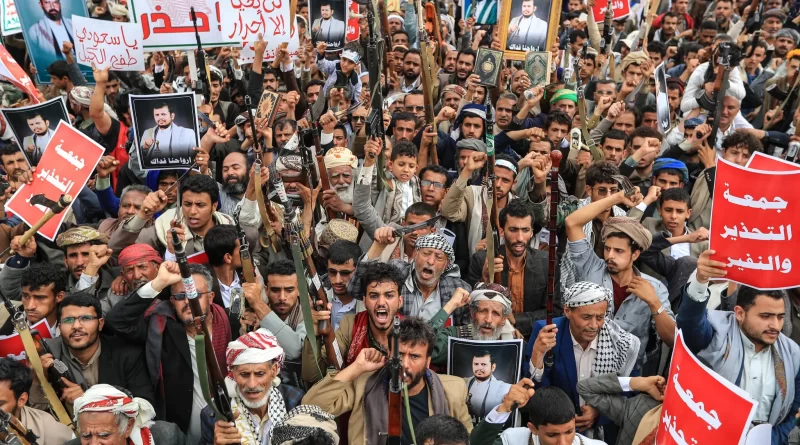
How the Houthis Cornered Saudi Arabia Into a New Conflict

The Iran-backed Houthi militia in Yemen has seized on a vulnerable moment for neighboring Saudi Arabia, which does not want another war. The group hopes to force political concessions in Yemen that could give it more authority and more access to resources.
After four years of political deadlock in Yemen, the Houthis were growing increasingly frustrated. A truce between the Iran-backed militia and neighboring Saudi Arabia had turned into a brittle stalemate, and the Houthis, feeling they had little to lose, wanted greater authority over Yemen and its oil resources.
Saudi officials, for their part, had no interest in another clash with the Houthis. Their previous bombing campaign in Yemen had turned into a decade-long quagmire thatcontributed to the deaths of hundreds of thousands of Yemenis from violence, hunger and disease. They wanted to avoid another expensive conflict that could endanger their plans to transform the kingdom into a business and tourism hub.
Into this tinderbox, the U.S. war with Iran flung a spark. Over the past few weeks, the Houthis and Saudi Arabia have spiraled into new clashes that risk expanding into another full-blown war.
“The Houthis have one solution for every problem in the world, which is go to war,” said Farea al-Muslimi, a Yemen-focused fellow at the London-based research group Chatham House. “The Saudis solve every problem by trying to shower it with money,” he added, “and the Houthis by shooting at it.”
The last Saudi-Houthi war pushed Yemen to the brink of famine. It paused with a fragile truce in 2022, but talks toward a durable peace deal eventually stalled.
The limbo was never going to last, but Saudi Arabia, distracted by other crises, appeared to hope it would hold a bit longer.
The Saudi ambassador to Yemen, Mohammed al-Jaber, said in a social media post on Saturday that the kingdom was keen to de-escalate. He blamed the Houthis for “insisting on a path of escalation and violence” and accused them of serving foreign agendas in an apparent reference to Iran.
But the battle-hardened Houthis may think they have much to gain from a new confrontation with Saudi Arabia, including access to Yemeni oil revenue and greater authority over the country, according to officials and diplomats who have dealt with the militia.
“Our souls are content with any level of sacrifice,” Abdulmalik al-Houthi, the group’s leader, said in a televised speech on July 16, after tensions with Saudi Arabia spiked.

Risk of a new all-out war grows
The Houthis are acting in support of their main ally, Iran, but also to force Saudi Arabia and the international community to make political concessions in Yemen, according to researchers who study the group.
In the past week, the Houthis have fired missiles and drones into Saudi Arabia and at ships in the Red Sea, disrupting already volatile global energy markets, while a Saudi-led military coalition has carried out airstrikes in Houthi-held territory for the first time in years.
“There is a real concern that the internal Yemeni war could reignite,” said April Alley, an analyst who worked on Yemen’s peace process at the United Nations and is now a senior fellow at the Washington Institute, a research organization.
This account of the situation in Yemen is based on interviews with Yemeni officials, current and former Western diplomats involved in Yemen’s peace process and regional analysts. Many spoke on the condition of anonymity to discuss the details of sensitive political negotiations.
The Houthis have chosen a vulnerable moment for Saudi Arabia, analysts say. Saudi Arabia typically exports most of its oil through the Strait of Hormuz, a narrow waterway that Iran has effectively blocked since the Iran war began. The kingdom now depends on the Red Sea to export oil — the lifeblood of its economy.
“The Houthis are good at smelling blood in the water,” said Ms. Alley.
The Saudi response so far has been calibrated to try to avoid getting sucked into a broader war, said Ahmed Nagi, a senior analyst for Yemen at International Crisis Group. But if they hold back entirely, they risk emboldening the Houthis, he added.
“The Saudis were cornered, and they feel like there will be a higher cost if they stay silent,” he said.
Trapped in the middle of this power struggle are tens of millions of Yemeni citizens suffering from widespread deprivation. Some of them say that even a return to fighting would be better than their current despair.
“We’ve had enough of this hardship and we needed a way out, whether through dialogue or war,” said Ayman Abdulhaq, a 43-year-old father of four and taxi driver in the Houthi-controlled capital of Yemen, Sanaa. “People are always looking for a breakthrough, no matter the consequences,” he added.
The Houthis began as a ragtag group of Shiite Muslim rebels in Yemen’s mountainous north, with a slogan calling for death to America and Israel. With Iranian support, they started a civil war by overrunning the capital in 2014, routing the internationally recognized government in Sanaa.
Saudi Arabia, Yemen’s neighbor to the north, was alarmed at the idea of an Iran-backed militia on their border. A Saudi-led military coalition began a bombing campaign, backing anti-Houthi forces inside Yemen that were trying to restore the government.
But the war dragged on for years, and Saudi Arabia pulled back amid international pressure over its role in exacerbating Yemen’s already severe humanitarian crisis.
By the time the truce was declared, the Houthis had created a de facto state in northern Yemen. The south is nominally controlled by the internationally recognized government, which is financially and militarily dependent on Saudi Arabia.
Saudi officials still have final say over a variety of Yemeni affairs.

Houthi frustration with Saudi truce built over time
At first, it seemed like military fatigue and political will on both sides could lead to a lasting peace. In late 2023, with the help of the United Nations, Saudi Arabia and the Houthis came close to signing a preliminary peace deal — referred to by officials as a “road map” — that would have provided an outline for a long-term political resolution, according to Yemeni and Western officials involved in those efforts.
A key component of that deal was an agreement to enable salary payments to Yemeni government employees in Houthi territory, whose paychecks had been suspended during the war. The amount at stake was significant — between $1 billion and $2 billion annually, according to two Western diplomats and a Yemeni official briefed on the plan.
The money was mainly to come from Yemeni oil revenue, those people said, with additional Saudi government funding to fill any gaps, according to the Yemeni official. Yemen’s oil resources are outside Houthi territory, and the Houthis have been eager to gain access to them.
Before the deal could be finalized, however, the Hamas-led attack on Israel in October 2023, followed by Israel’s devastating war in Gaza, derailed Yemen’s peace process. The Houthis announced a military campaign in solidarity with Palestinians, shooting missiles and drones at Israel and at ships in the Red Sea.
Throughout the war in Gaza, the Houthis avoided attacking Saudi Arabia. But their attacks in the Red Sea drew the ire of countries that depended on the waterway for shipping. When President Trump began a second term in 2025, he declared the Houthis a foreign terrorist organization and launched a bombing campaign against them.
That designation worsened an already painful economic situation in areas under Houthi control, and growing resentment put pressure on the group, said Mr. al-Muslimi, the Chatham House researcher.
Abu Bakr al-No’man, a 48-year-old father of two in Sanaa, used to earn about $130 monthly as a civil servant but said he now struggles to find enough food and water for his family to get through the day. Like many, he has become desperate for a way out.
“Escalation is the solution,” he said.
After mostly sitting out U.S.-Iran war, Houthis join fray
Mohammed al-Bukhaiti, a senior Houthi political official, blamed Saudi Arabia for “failing to implement any of the provisions of the road map, foremost among them the payment of salaries for all state employees.”
He said in an interview that Saudi Arabia was at fault for the current escalation, and he accused the kingdom of imposing unjust restrictions on aviation and shipping to Yemen, which the Houthis and many Yemenis in their territory describe as a blockade.
In February, when the United States and Israel went to war with Iran, the Houthis seemed willing to stay on the sidelines. Months later, after a cease-fire between the United States and Iran fell apart, the calculus for the Houthis altered.
That change may have been triggered by Iranian pressure to get involved, although intervention also serves Houthi goals, several analysts said.
This month, the Houthis began insisting that an Iranian plane fly into Sanaa, where flights had been suspended for a year. Houthi officials called the plane’s arrival a bid to break the blockade.
Describing themselves as the sovereign government of Yemen, the group demanded the lifting of all restrictions — including a U.N. inspection regime — on planes and ships entering their territory.
One Western diplomat said there were talks about reopening flights but the Houthis had refused several proposals.
When a second Iranian flight tried to land in Sanaa, the Houthis accused Saudi Arabia of bombing the airport. The Saudi-backed Yemeni government claimed it had launched airstrikes to force the plane to divert and accused the Houthis of using the flights to import Iranian weaponry, which the Houthis denied.
The Houthis subsequently declared a blockade on Saudi ships in the Red Sea. Each side has claimed attacks on the other since then.
Whether things escalate further could depend on the Trump administration’s stance.
A senior Trump administration official told the Times that the United States will empower its allies to take the lead in regional security and supports a diplomatic resolution in Yemen.
On July 23, Mr. Trump threatened on social media to inflict “major military punishment” on the militia if they continue to attack Saudi oil tankers. He expressed disappointment with the Houthis, saying that they had, “until now, acted very professionally and smart.”
==============================================
is the lead reporter for The Times covering the countries of the Arabian Peninsula. She is based in Riyadh, Saudi Arabia.