
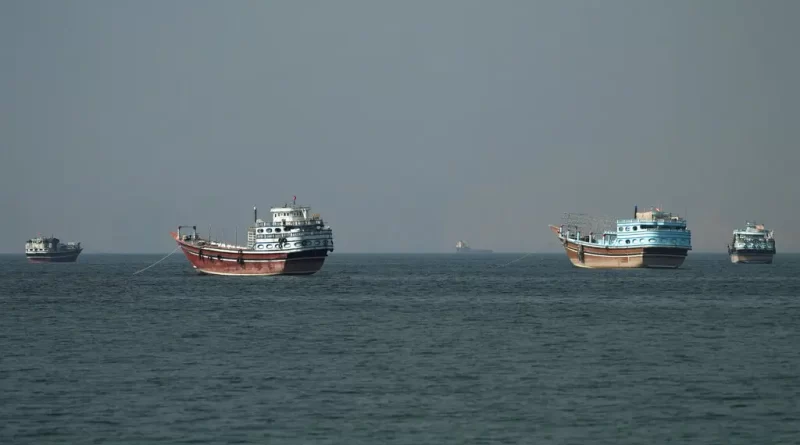
Vague Language of U.S.-Iran Deal Comes Back to Haunt Peace Efforts

The deal called for Iran to “make arrangements” for the passage of ships through the Strait of Hormuz. Iran has interpreted that to mean it can designate which routes ships take.

The ambiguities in the language that U.S. negotiators agreed to in their interim cease-fire agreement with Iran appear to be coming back to haunt them, less than two weeks after the two sides signed the deal.
That much is clear from the surge in violence over the last 72 hours, which began on Thursday when Iranian forces struck a container ship passing through the Strait of Hormuz, a vital waterway for shipping oil and natural gas.
The memorandum that the two sides agreed to calls for Iran to “make arrangements using its best efforts for the safe passage of commercial vessels” through the Strait of Hormuz for 60 days. Crucially, it leaves “arrangements” and “best efforts” undefined.
Iran appears to have interpreted that language to mean that it can determine which route ships must take. Hours before its attack on the container ship, Iran had warned ships that the only route through the strait was through its waters, trying to stop vessels from using an alternate, U.S.-backed route on the southern side of the strait that hugs the coastline of Oman.
The interim deal “leaned on deliberately flexible language because that was probably the only way to get it over the line,” said Nicole Grajewski, an assistant professor at the Center for International Studies at Sciences Po in Paris. “But flexibility only holds while both sides attach similar meanings to the same vague provisions.”
The vagueness of the interim agreement has led both sides to try to define facts on the ground to their advantage, before any uncertainties are resolved in a final deal, she added.
Gregory Brew, a senior analyst at Eurasia Group, said Iran was trying to see how far it could push its influence over the strait.
“If some minimal military action is enough to close the Omani route and move shipping into routes Iran can control, why not give it a shot?” Mr. Brew wrote on social media on Saturday. “The risks are low so long as Iran can be confident that the U.S. won’t return to more aggressive action.”
The United States retaliated late Friday for the cargo ship attack, striking Iranian missile and drone storage sites and coastal radar facilities. Hours later, Bahrain reported that it had come under attack from Iranian drones.
The back-and-forth threatens to derail an already fragile pause in the fighting between the two sides, even as they are supposed to be settling many of their differences — and fleshing out the uncertainties of the initial agreement — at the negotiating table.
It also raises questions about claims made this week by Vice President JD Vance in an interview with UnHerd, in which he said a channel had been set up between the Iranian and U.S. militaries aimed at de-escalating the conflict.
Multiple Iranian news outlets quoted a spokesman of the Islamic Revolutionary Guards Corps, Hossein Mohebbi, as denying that any hotline had been established regarding the strait.
Mohsen Rezaei, a former Iranian military commander who is an adviser to Ayatollah Mojtaba Khamenei, the Iranian supreme leader, accused the United States on Saturday of “continuing to create tensions” in the Strait of Hormuz and violating the interim peace agreement with Tehran. “The response to the violation of any article of the memorandum of understanding will be swift and decisive,” he said in a post on social media.
Iranian officials in both the civilian government and the military have asserted that, postwar, the country will manage traffic in the Strait of Hormuz, though some officials have said they will do so in conjunction with Oman, which sits across the strait. Iran has asserted a right to charge ships for passage through the waterway, saying the levies would not be tolls, but fees for unspecified services.
That is opposite from the position taken by the United States. Secretary of State Marco Rubio said this week that “no country” could charge ships for passage through the strait. The language of the interim deal, however, only guarantees free transit through the strait for 60 days.
“Washington treats ‘toll-free transit’ as a permanent principle, while Tehran reads the 60-day waiver as a tactical pause it accepted only to reach a deal,” Ms. Grajewski said.
================================
Yeganeh Torbati is the Iran correspondent for The Times.