
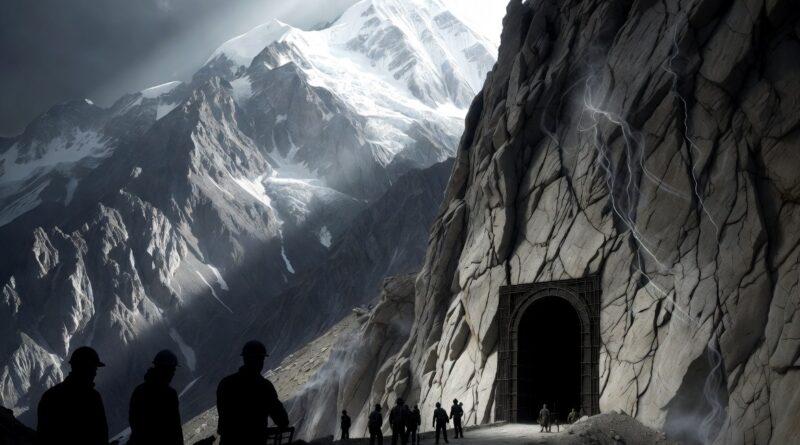
Unsafe Lives in the Himalayan Tunnels
Himalayan tunnel projects face repeated accidents—from Sikkim’s methane gas explosion and Silkyara rockfalls to the Chamoli floods—exposing chronic safety lapses and flawed DPRs. Despite known geological risks of unstable rocks, seismic activity and toxic gases, standards are poorly enforced. Migrant workers pay with their lives. Development remains essential, but independent reviews, real-time monitoring and strict accountability are urgently needed to safeguard both workers and the fragile Himalayas.

— Jay Singh Rawat
The major loss of life caused by a methane gas explosion in the under-construction tunnel of the Teesta Stage-6 hydroelectric project in Sikkim, and the recent death of a worker due to a rockfall in the Silkyara-Barkot tunnel in Uttarakhand, have once again raised serious questions about the safety of ongoing tunnel projects in the Himalayas. This is not the first such incident. In November 2023, 41 workers remained trapped for 17 days in the Silkyara tunnel. At that time, national and international attention was focused on the accident, an unprecedented rescue operation was launched, and the workers were safely brought out. But the fundamental questions that arose after that incident—how accurate was the geological assessment, were safety standards followed, why did the prior risk assessment fail?—have still not been answered publicly. Now, another life has been lost in the same project. Looking at it, not only lives but the Himalayas themselves are unsafe in these tunnels.
The accident in Sikkim has deepened this concern further. It is being reported that a methane gas explosion occurred in the tunnel. This is neither an unexpected nor an unknown risk. In tunnel engineering, methane gas, toxic gases, groundwater pressure, and unstable rocks are counted among the biggest hazards. Standard operating procedures for these have existed worldwide for decades. The question is: if the dangers are known, why do accidents keep happening again and again?
In fact, the Himalayas have today become the country’s largest construction laboratory. Hydroelectric projects, the Char Dham road project, the Rishikesh-Karnaprayag railway line, border roads in states such as Kashmir, and strategic tunnels like those at Zojila and Sonamarg—a network of tunnels is being laid in every direction inside the mountains. In the coming years, both their number and length are set to increase manyfold. But is the safety system also being strengthened in the same proportion? If one looks at the incidents of the past decade and a half, the concern only grows. In February 2021, the devastating flood in the Rishiganga and Dhauliganga rivers in Chamoli district destroyed NTPC’s Tapovan-Vishnugad hydroelectric project. A large number of workers and employees working in the under-construction tunnel were swept away by debris and water. Around 200 people died or went missing. Despite a rescue operation lasting several days, most people could not be saved. This tragedy was not merely a natural disaster; it also raised serious questions about disaster preparedness and risk assessment in Himalayan projects.
Even before that, several accidents occurred during the underground construction of the Tehri Dam project. Workers lost their lives due to rockfalls in tunnels, flooding, and technical reasons. After these incidents, talk of safety improvements was heard, but even today the chain of accidents in Himalayan tunnels does not appear to be stopping. The Himalayas are not an ordinary mountain range. This is the world’s youngest mountain system, which is still geologically active. The rocks here are weak in many places, seismic activity is high, and pockets of flammable gases such as methane exist in several areas. That is why tunnel construction here is far more complex and risky than in the plains. This is precisely why detailed geological studies, prior gas investigation, drainage boreholes, effective ventilation, real-time monitoring, and emergency evacuation arrangements are considered mandatory in every project.
But are these standards being followed with complete rigour in our projects? This question is not new. Union Minister Nitin Gadkari has often strongly criticised the poor quality of Detailed Project Reports (DPRs) prepared by Indian consultancy firms for tunnelling and highway projects. He has identified poor DPRs and defective civil engineering as the main reasons for delays, cost overruns, and terrible accidents in projects in sensitive areas. If deficiencies remain in the initial geological study and design itself, it is natural for dangers to increase during construction. In a sensitive region like the Himalayas, even a small error in the DPR can prove costly. The misfortune is that after every major accident, inquiry committees are formed, compensation is announced, and safety is debated for some time. Then the matter gradually cools down. Inquiry reports are often not made public, or the lessons drawn from them do not appear to be applied widely. As a result, the next accident again places us at the same point.
The highest price is paid by those workers who are the real strength of these projects. Most workers come from migrant and economically weaker families. They work under difficult conditions inside the mountains. After an accident, their families may receive compensation, but the lost life never returns.
It would not be right to say that development work in the Himalayas should stop. Border states need better roads, rail connectivity, tunnels, and energy projects. Their importance is undisputed from the point of view of national security and regional development. But development and safety cannot be treated as alternatives to each other. If state-of-the-art machines can be installed in a project worth thousands of crores of rupees, the highest investment must also be made in the safety of workers. The time has now come to prepare a separate safety framework for Himalayan tunnel projects. There should be an independent geological review of every project, mandatory re-evaluation of DPRs by experts, real-time monitoring of gas and geological activities, public safety audits, and clear accountability in the event of an accident.
The success of projects should not be measured only by timely construction, but by safe construction and the condition of the Himalayan ecosystem. Sikkim, Silkyara, Chamoli, and Tehri—these four names are not separate incidents. They are continuous warnings being given by the Himalayas. If we treat even these warnings merely as coincidences of accidents and move ahead, then perhaps another tragedy will be waiting for us at the mouth of the next tunnel of development. The progress of any nation should not be measured by the number of its tunnels, but by the safe return home of every worker working in those tunnels. Along with this, the health of the Himalayas must also be given the highest priority.
=====================
ABOUT AUTHOR: –
Jay Singh Rawat is a veteran journalist, researcher, and author with nearly five decades of experience covering the Himalayan region. Based in Dehradun, his work focuses on environmental ecology, tribal history, regional governance, and socio-political developments across Uttarakhand and the broader Indian Himalayas.Over his distinguished career in print and electronic media, Mr. Rawat has served as a reporter, special correspondent, and editor for various national news organizations, wire services, and regional publications.