
Catalyst that transforms to perform

Scientists have unveiled how the structure of a widely used catalyst transforms itself while triggering the electrolysis of water to yield green hydrogen. This can help guiding the design of efficient, next-generation electrocatalysts for efficient, low-cost hydrogen production.
One of the simplest ways to produce hydrogen, the clean fuel of the future is by splitting water using electricity. But this process only works well if we have good catalysts that make the reaction faster and more efficient.
People assume that catalysts as fixed and stable, doing their job without changing. In reality many catalysts behave quite differently when they are actually in use. Their structure can shift during the reaction and these changes can have a big impact on how well they work.
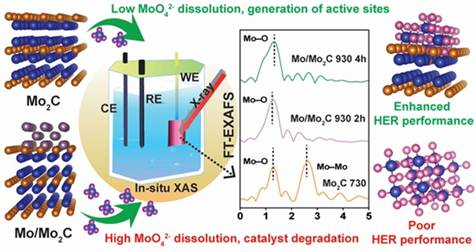
A research team led by Dr. Neena S. John and Ph.D. scholar Palash Jyoti Gogoi from the Centre for Nano and Soft Matter Sciences (CeNS), Bengaluru−an autonomous institute of the Department of Science and Technology (DST)−in collaboration with Dr. Chandraraj Alex from Kiel University, Germany, and Dr. Satadeep Bhattacharjee and Dr. Swetarekha Ram from the Indo-Korea Science and Technology Center (IKST), Bengaluru, have provided new insights into the behavior of molybdenum carbide (Mo2C), a widely studied earth-abundant catalyst, by uncovering how its structure evolves during the hydrogen evolution reaction (HER).
Through a combination of advanced experimental techniques, including in situ X-ray absorption spectroscopy (XAS) and in situ Raman spectroscopy, along with theoretical calculations, the researchers tracked how Mo2C changes during the hydrogen evolution reaction (HER).
The study demonstrates that Mo2C does not remain structurally static during HER, instead, it undergoes dynamic reconstruction, forming oxygen-deficient molybdenum oxide (MoOx) domains. These reconstructed species exhibit a local coordination environment closely resembling MoO2 and play a decisive role in facilitating H2 generation. Importantly, this transformation is not detrimental but rather beneficial, leading to improved activity and stability. In contrast, Mo/Mo2C heterostructures exhibit faster oxidation, resulting in the formation of soluble molybdate species and a consequent loss of catalytic activity. This comparison clearly demonstrates that controlled reconstruction in Mo2C promotes catalytic efficiency, whereas uncontrolled oxidation in Mo/Mo2C leads to degradation.
Beyond these observations this work establishes a fundamental link between local atomic structure, dynamic redox evolution, and electrocatalytic performance, offering new insights into how catalysts function under realistic operating conditions. It underscores that the true active phase is formed in situ, rather than being the pristine material itself, thereby identifying dynamic reconstruction as a key factor governing catalytic activity and guiding the design of efficient, next-generation electrocatalysts.
This work published in Material Horizons, highlights how harnessing dynamic reconstruction can unlock the full potential of Mo2C catalysts, paving the way for efficient, durable, and cost-effective hydrogen production systems.
Publication link: https://doi.org/10.1039/D5MH02010G