
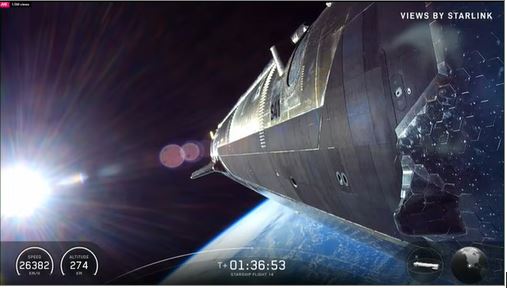
SpaceX’s Starship Makes It to Orbit for the First Time

The 14th test flight marks a crucial milestone toward the company’s ambitions of sending people to the moon and Mars.

On its 14th test flight, SpaceX’s Starship is finally circling the Earth. That’s important because for Starship to deploy satellites, travel to more distant destinations like the moon and achieve Elon Musk’s dreams of sending people to Mars, it has to first enter orbit.
Several minutes of tense waiting followed after liftoff because one of the six engines on the second-stage spacecraft failed. The other engines fired longer to compensate.
After analysis, SpaceX engineers decided to continue the rest of the mission as planned for Starship to enter orbit.
For the first 13 flights, Starship went up from Texas and, when it did not blow up en route, came back down half a world away in the Indian Ocean. That way, if the spacecraft spun out of control while in space, as it did during the ninth test flight in May 2025, the debris would splash down harmlessly, far from people.
But a rocket that comes down as soon as it goes up is of little use. This test flight marks the critical milestone of entering orbit.
When is the launch, and how can I watch it?
SpaceX launched Starship at 8:48 a.m. Eastern on Monday from its Starbase site outside Brownsville, Texas.
You can watch SpaceX’s coverage of the test flight in the video player above.
What is Starship?
Starship is the largest and most powerful rocket ever built. It is 407 feet tall and consists of an upper-stage spacecraft, also called Starship and often shortened to Ship, and a powerful booster stage with 33 engines known as the Super Heavy.
The design aims to be fully reusable; eventually both stages will return to the launch site to be caught by giant mechanical arms.
If SpaceX pulls off this vision, Starship would revolutionize the space industry, enabling launches of bigger, heavier satellites and other cargo at lower costs.
“It’s designed for not just full reusability but also rapid reusability, like an aircraft,” Mr. Musk, the founder and chief executive of SpaceX, said this month during the All-In Summit, a business and technology conference.

Why has it taken so long to launch an orbital flight of Starship?
To put something as big as Starship in orbit, SpaceX, as well as the Federal Aviation Administration, which regulates launches and re-entries, needs to be sure that the spaceship can drop out of orbit and return safely to a targeted spot on Earth.
This kind of controlled re-entry avoids the drama of the Chinese Long March 5B rocket launches a few years ago. Because the density of Earth’s upper atmosphere is always changing, it was impossible to know where those uncontrolled Chinese rocket stages would fall. Although the chances that someone would be injured or killed were low, they were not zero.
Mr. Musk had predicted that an orbital Starship flight would occur earlier, but several failed flights slowed progress. An improved Starship design has performed better during the 12th and 13th test flights this year.
And the 13th test flight, in July, demonstrated that Starship could restart one of its engines while in flight, the essential capability needed for controlled re-entry.
Was the last test flight a total success?
During the flight, Starship for the first time deployed 20 functioning, next-generation Starlink satellites. All the satellites successfully connected to the rest of the Starlink constellation via laser communications. That triumph, however, was short-lived. The satellites were on the same suborbital path as Starship and burned up in the atmosphere 20 minutes after being deployed.
The upper-stage spacecraft survived the fiery re-entry and made it all the way to the Indian Ocean, where it simulated a landing over the water. It was so gentle that the spacecraft remained intact and floating even after toppling over on its side. (Earlier splashdowns had ended with fiery explosions when the leftover methane fuel ignited.)
SpaceX towed the spacecraft to Christmas Island, an Australian territory, allowing for close-up inspection.
The Super Heavy booster stage, however, encountered some problems. It performed its primary task of pushing the upper stage toward space. But the engine burn to turn the booster around toward a water landing was cut short because of signs of ice clogging the three center engines, SpaceX reported. For the final landing burn, 13 engines should have fired, but only eight reignited, and the booster hit the water hard.
SpaceX said it had made changes to the engines and software to improve the reliability of the booster relights.
What happened during this test flight?
After the rocket launches from Starbase, the Super Heavy booster pushed it upward for about 2 minutes 22 seconds before falling away.
The upper-stage Ship continued to space. Because one of the six engines failed, the other five fired longer than planned. The upper-stage then continued coasting upward for more than 17 minutes. Starship fired one engine for 19 seconds to put it in a circular orbit about 171 miles above Earth’s surface.
The spacecraft will go around the planet about six times. During that time, it deployed 26 next-generation Starlink satellites, which will become operational parts of SpaceX’s internet communications network.
After nearly nine hours in space, Starship will fire one engine for 11 seconds, enough of a nudge to send it falling back toward Earth.

Will SpaceX try to catch the two rocket stages?
One of the most thrilling breakthroughs SpaceX has achieved was during the fifth test flight, when the Super Heavy booster returned to Starbase and was caught in midair by two large mechanical arms on the launch tower. SpaceX repeated that feat during the seventh and eighth test flights.
SpaceX wants to eventually catch the upper-stage Ship when it returns to Earth, allowing both parts to be used again for future flights.
But for this test flight, SpaceX will not try to catch either. The booster made a simulated landing in the Gulf of Mexico, and the upper stage will simulate a landing in the Pacific Ocean to the west of Chile.
For the booster, SpaceX needs to verify that the latest changes have fixed the problems that caused previous failures. The company also wants a bit more experience before Ship returns to Starbase because it will pass over a swath of the United States.
“What we’re most concerned about is if the Ship were to break up over land and rain debris on people,” Mr. Musk said. “Our popularity would diminish very rapidly.”
Why is this flight important for SpaceX and NASA?
NASA hired SpaceX to provide a version of Starship to take its astronauts from lunar orbit to the surface of the moon. But work on Starship has taken longer than Mr. Musk and SpaceX originally promised.
For the moon mission, SpaceX needs to demonstrate several technological firsts. That includes conducting multiple Starship launches over a short period of time, because the lunar lander version of Starship will need to have its propellant tanks refilled by another spacecraft before leaving low-Earth orbit.
Transferring ultracold liquid methane and liquid oxygen between two spacecraft in the weightlessness of space has also not yet been demonstrated.
Those more ambitious goals cannot be pursued until SpaceX shows it can reliably launch Starship into orbit.
A success could also strengthen the confidence of investors. SpaceX debuted on the stock market in June in the largest initial public offering ever. Its stock price shot upward, then plummeted. In recent weeks, it has moved upward again to about $150, modestly higher than the $135 initial offering price. (With courtsey from the New york Times)
=========================================================
Kenneth Chang, a science reporter at The Times, covers NASA and the solar system, and research closer to Earth.